
2026: FG targets N34.33trn revenue, pegs exchange rate at N1,512/$1
The Federal Executive Council (FEC) has approved the 2026–2028 Medium-Term Expenditure Framework (MTEF) and Fiscal Strategy Paper, projecting that the federal government expects to generate N34.33 trillion in revenue in the 2026 fiscal year.
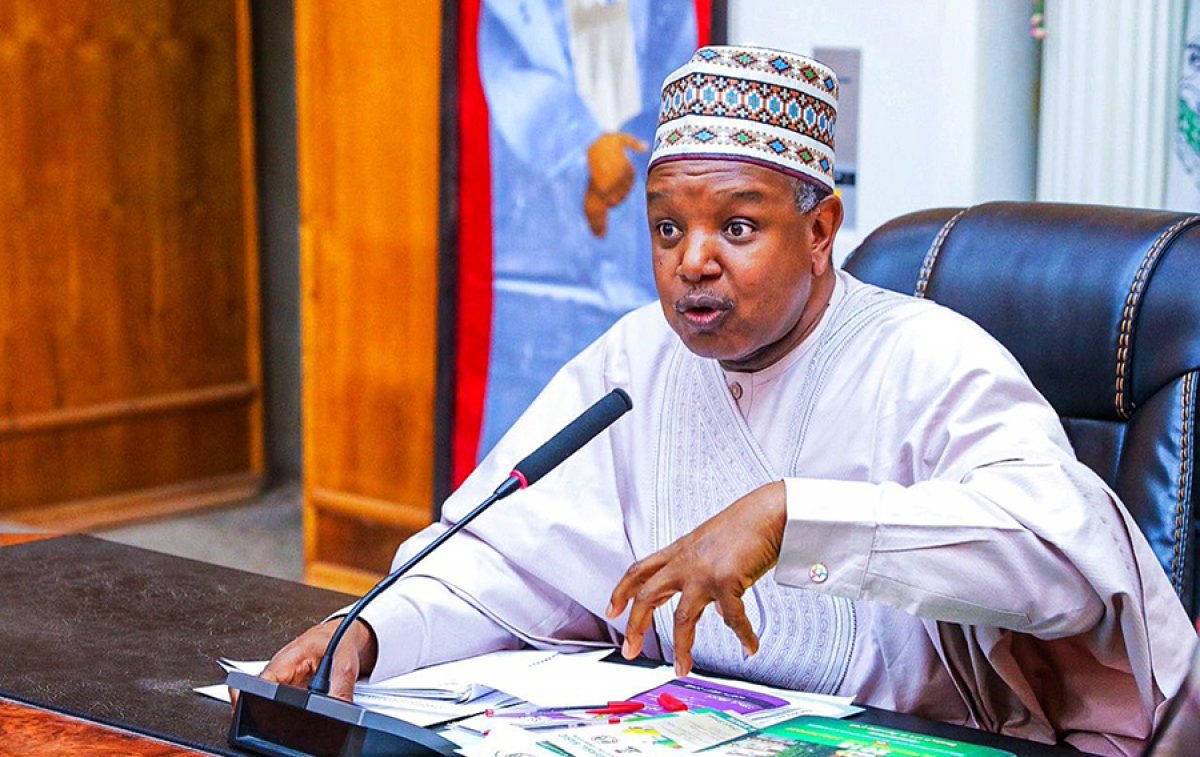
Addressing State House correspondents after the FEC meeting presided over by President Bola Ahmed Tinubu, the Minister of Budget and Economic Planning, Atiku Bagudu, said the document was presented to the FEC by the Budget Office of the Federation.
He added that the presentation was delivered by the director-general of the office, Tanimu Yakubu, on behalf of the ministry.
Bagudu said the council adopted an oil production target of 2.06 million barrels per day for 2026, while a more conservative figure of 1.8 million barrels per day will be used for budget planning purposes.
An oil benchmark price of $64 per barrel was approved, alongside a projected exchange rate of N1,512 to the dollar, he added.
He noted that the exchange rate assumption was factored into the fiscal outlook with the 2027 general elections in mind.
Bagudu said the federal government expects to generate N34.33 trillion in revenue in 2026, reflecting ongoing efforts to deepen non-oil earnings, improve tax administration, and broaden the national economic base.
He added that the council also reviewed comments from cabinet members before approving the Medium-Term Fiscal Expenditure Ceiling (MFTEC), which sets spending limits and reinforces fiscal discipline.
Bagudu said: “The target oil production, as well as the benchmark oil production, is 2.06 million barrels per day, which the management of the oil industry is tasked to achieve.
“However, to avoid revenue shortfalls, we use a benchmark oil production figure of 1.8 million barrels per day for budget purposes.
“For prudence, we are using $64.85 per barrel and an exchange rate of N1,512 to the dollar for 2026, given that it is a pre-election year. Election activities can typically affect the exchange rate, and the gross rate is projected at $4.68.
“Regarding distribution among the tiers of government, the Federal Government is projected to receive N22.6 trillion from the Federation Account, while the state and local governments are expected to receive N16.3 trillion and N11.85 trillion, respectively.”
Bagudu reiterated that the federal government’s projected revenue for 2026 reflects sustained efforts to boost non-oil earnings, strengthen tax administration, and expand the nation’s economic base.
According to the approved MTEF, the federal government’s expenditure breakdown by major heads shows that statutory transfers are projected at around N3 trillion, debt service expenditure at N15.91 trillion, and non-recurrent expenditure—which includes personnel costs—at about N15.27 trillion.
The fiscal deficit is projected at N20.1 trillion, representing 3.61% of the estimated GDP.
Bagudu said President Bola Ahmed Tinubu has taken several steps to strengthen coordination across the three tiers of government.
This, he said, includes inviting state and local governments to meetings of the National Economic Council (NEC) to encourage greater collaboration between fiscal and monetary policies.
Bagudu noted that President Tinubu also sought NEC’s approval for enhanced vigilance nationwide to curb revenue leakages arising from illegal activities in the oil and gas sector, as well as in the exploitation of critical minerals.
He added that the full implementation of these measures, alongside the MTEF and Fiscal Strategy Paper, is expected to catalyse stronger and more sustained economic growth.
Overlapping budgets
Responding to questions from State House correspondents on overlapping budgets, the Minister of Finance and Coordinating Minister of the Economy, Wale Edun, said, “There is a commitment to revert to a normal budget cycle, January to December. That is the goal.”
He noted that achieving this requires all parties to agree and work together toward normalising the capital budget cycle, while the recurrent budget already runs from January to December.
Speaking on the timeline for the 2026 budget, Atiku Bagudu said the Executive and the National Assembly will liaise to agree on an amicable date for submission.
“The answer lies with the National Assembly, because we don’t want to pre-empt their schedule or take their permission for granted.
“The protocol is that once the budget is ready, it is submitted to the President, approved by the Federal Executive Council, and presented to the National Assembly. President Tinubu, as an ardent believer in institutions, has always respected this process.”
He added that with the approval of the Medium-Term Expenditure Framework and other measures taken by the FEC, there is now a clear guide for concluding the 2026 budget.
He said a significant portion of the 2025 capital expenditure will be rolled over to 2026, and, if approved by the National Assembly, ministries will utilise these allocations accordingly.
Nigerians can now invest ₦2.5 million on premium domains and profit about ₦17-₦25 million. All earnings paid in US Dollars. Rather than wonder, click here to find out how it works.
Join Daily Trust WhatsApp Community For Quick Access To News and Happenings Around You.




Discussion (0)