
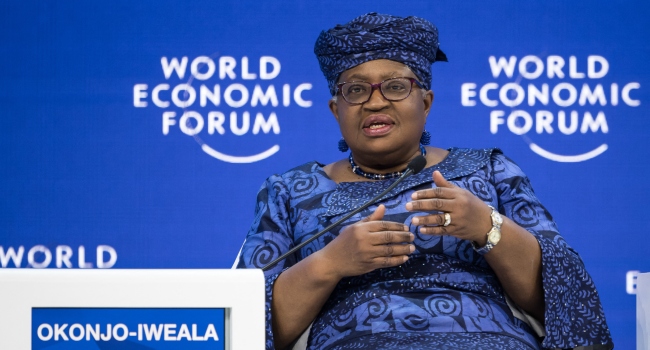
Davos: Nigeria Must Deliberately Target Global Investors — Okonjo-Iweala
Director-General of the World Trade Organisation, Dr. Ngozi Okonjo-Iweala, urged the Federal Government to aggressively target global investors and leverage the shifting landscape of international supply chains to reduce import dependence, deepen domestic manufacturing, and drive job creation.
Speaking on Wednesday at Nigeria House during the ongoing World Economic Forum (WEF) in Davos, Switzerland—where Nigeria is making a high-profile debut with its first-ever sovereign pavilion on the Davos promenade—Okonjo-Iweala said rising geopolitical tensions had accelerated supply chain diversification in ways African economies can benefit from.
The panel, titled “From Scale to Capital: Financing Nigeria’s Role as Africa’s Digital Trade and Infrastructure Anchor,” drew business and policy leaders to discuss how nations like Nigeria can capture new global economic opportunities.
“Firms are increasingly adopting China+1 sourcing strategies to reduce single-country risk, although China remains deeply embedded in many global value chains,” Okonjo-Iweala said.
“In addition, tariffs and trade restrictions have incentivised companies to reconsider reliance on dominant suppliers, prompting the relocation or diversification of production hubs,” she stated.
READ ALSO: [UPDATED] US Is ‘Economic Engine Of The Planet’, Trump Tells World Leaders In Davos
According to the WTO chief, these disruptions present a genuine window for Nigeria to capture a share of global supply chains—but only if authorities and the private sector pitch the country boldly and strategically.
Okonjo-Iweala, a former finance minister, noted that while some good reforms are underway, they must translate quickly into employment gains.
“That was what I said to His Excellency—that we need to move from stabilisation to job creation, because that is where we are lacking. It is not going to be overnight, but they are moving in the right direction,” said the trade chief.
She stressed the need to identify where the opportunities lie and then pursue them relentlessly:
“What I think they need to do is map where the opportunities are.”
Okonjo-Iweala urged Nigeria to take its pitch directly to investors wherever they are.
She emphasised intentional strategies to court investors across key markets.
“What I would like to see is a continued effort to attract investment into the country, because there is an opportunity now to attract these supply chains. If there is one thing I would say, it is that everything we can do to showcase Nigeria as a country worthy of investment is what we should be doing.
“And we should deliberately have strategies to go after those investments and investors—to go to China, the US, whatever it takes—to come and invest in our country,” she added.
The WTO DG also highlighted that, even as many companies diversify away from China, much of that movement remains within Asia—and Nigeria must position itself to capture a sizeable bite of that trend.
Okonjo-Iweala, speaking further, said, “Let’s build solar panels in Nigeria. We are importing, but we can also manufacture. We have the renewable capacity.”
She pointed to fashion as another fertile sector.
“In fashion, let them come to invest. Every time I buy a piece of wax (textile), I check to see where it’s made. Let’s attract investment to make it at home rather than elsewhere.
“This applies to pharmaceuticals too—there is a chance there as well,” she added.
The call to action comes at a moment of heightened ambition for Nigeria at the 56th WEF. Vice President Kashim Shettima is leading a high-level delegation to Davos, where Nigeria House is serving as a national showcase for investment opportunities, economic reforms, and strategic partnership goals—from solid minerals to technology and climate-smart agriculture.
Nigeria’s economic leaders, like the Minister of Industry, Trade, and Investment Jumoke Oduwole, are also telling the world that the country’s economy is showing strong recovery, easing inflation, and renewed investor confidence, using forums like Davos and the Nigeria House platform to underline that message.



Discussion (0)