
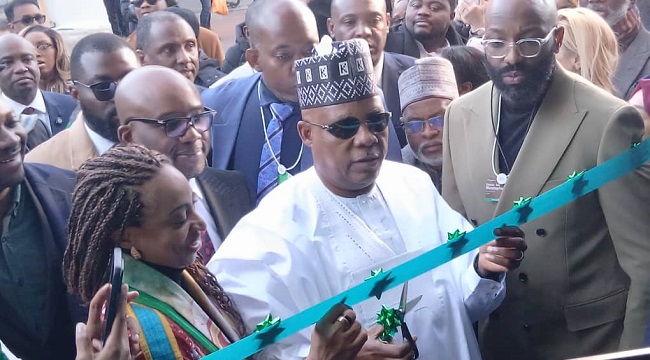
VIDEO: Shettima Formally Unveils Nigeria House In Davos
In a historic first, the Federal Government has officially opened Nigeria House in Davos, Switzerland, coinciding with the kickoff of the 2026 World Economic Forum (WEF).
The unveiling, led by Vice President Kashim Shettima, marks Nigeria’s debut in establishing a dedicated platform at the global forum to showcase its investment potential.
The Nigeria House is designed to serve as a strategic hub for engaging international investors, promoting key sectors of the economy, and facilitating discussions on partnerships, policies, and foreign direct investment.
<span data-mce-type="bookmark" style="display: inline-block; width: 0px; overflow: hidden; line-height: 0;" class="mce_SELRES_start"></span>
The official opening was attended by members of the Nigerian delegation, alongside foreign partners and stakeholders.
Vice President Shettima said the opening demonstrates that the dividends of the President Bola Tinubu administration’s reforms are beginning to materialise.
He described the Nigeria House as a global business roundtable focused on building a resilient supply chain network for the energy transition.
“Nigeria House may have been conceived as a whole-of-government platform, led by the Minister of Industry, Trade and Investment, with senior leadership across investment, foreign affairs, energy, infrastructure, technology, climate, and culture gathered under one roof,” he said.
“But its true essence must come from the private sector. Government can open doors, create frameworks, and de-risk environments. Only enterprise can animate growth, scale opportunity, and translate policy into productivity.
“This house will thrive to the extent that it draws light from private capital, private innovation, and private confidence,” the VP added.
<img fetchpriority="high" decoding="async" class="alignnone size-large wp-image-996563" src="https://www.channelstv.com/wp-content/uploads/2026/01/WhatsApp-Image-2026-01-19-at-7.27.19-PM-1024x768.jpeg" alt="" width="660" height="495" srcset="https://www.channelstv.com/wp-content/uploads/2026/01/WhatsApp-Image-2026-01-19-at-7.27.19-PM-1024x768.jpeg 1024w, https://www.channelstv.com/wp-content/uploads/2026/01/WhatsApp-Image-2026-01-19-at-7.27.19-PM-300x225.jpeg 300w, https://www.channelstv.com/wp-content/uploads/2026/01/WhatsApp-Image-2026-01-19-at-7.27.19-PM-768x576.jpeg 768w, https://www.channelstv.com/wp-content/uploads/2026/01/WhatsApp-Image-2026-01-19-at-7.27.19-PM-1536x1152.jpeg 1536w, https://www.channelstv.com/wp-content/uploads/2026/01/WhatsApp-Image-2026-01-19-at-7.27.19-PM.jpeg 1600w" sizes="(max-width: 660px) 100vw, 660px" />
Minister of Industry, Trade and Investment, Jumoke Oduwole, highlighted that Nigeria is showcasing four major investment sectors at the forum: solid minerals, sustainable agriculture, the creative industry, and the digital economy.
“The Nigeria House exists for one purpose: to make it easier for credible partners to understand our market, engage our businesses and institutions, and move from interest to partnership,” Oduwole said.
She noted that the initiative reflects a broader shift in how Nigeria engages the world in a way that is “less fragmented, more coordinated, more intentional, and reflective of stronger institutional alignment, clearer accountability, and a shared focus on delivering on Mr. President’s economic agenda.”
Finance Minister and Coordinating Minister of the Economy, Wale Edun, emphasized that the Federal Government is prioritizing domestic revenue growth over heavy reliance on borrowing. While open to international capital markets, borrowing is no longer the centerpiece of Nigeria’s fiscal strategy.
Edun explained on Bloomberg Television that Nigeria’s economic strategy builds on reforms introduced since 2023, including the removal of fuel subsidies, liberalization of the foreign exchange market, and a comprehensive overhaul of the tax system.
The government aims to raise tax revenue to 18 percent of GDP by 2026, up from 14 percent, funding development priorities without excessive debt. “The issue now is to focus on revenue, focus on domestic resource mobilisation. We’re hoping to rely less on borrowing,” Edun added.
Despite weaker global oil prices, Nigeria’s economic outlook is showing early signs of improvement. The International Monetary Fund (IMF) recently upgraded Nigeria’s growth forecast to 4.4 percent for 2026, attributing this to ongoing reforms that strengthen fiscal sustainability and revenue stability.
Community Reactions
AI-Powered Insights
Related Stories

Akintunde Ayeni :Business Without Continuity Plan Already Dead

This Billionaire Traded Glam for Mission to Industrialise Nigeria
Finance and insurance sector grows by 14.54% in 2025 – NBS

Discussion (0)