
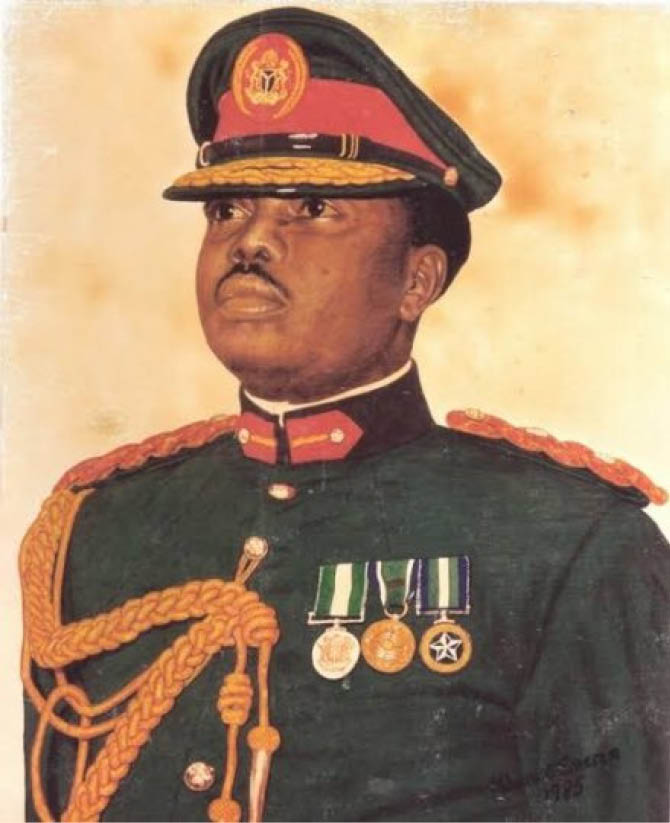
The legacies of General Murtala Muhammed, 50 years on
On the morning of February 13, 1976 General Murtala Rahmat, the then military head of state of Nigeria left his residence for Dodan Barracks, the seat of power. As he rounded the bend to link up with the main road leading to Dodan Barracks, his modest motorcade consisting of the official car he was riding in and a follow up car, a volley of shots rang out from assailants who had taken up positions at the spot.
As it later came to be known, the assailants were Lt. Colonel Bukar Suka Dimka, Major Kassai and Sgt. William Seri and two others. Dimka, who led the team ordered Sgt. Seri to shoot at General Muhammed and Kassai to target the Aide-de-Camp of the General, Lt Akintunde Akinsehinwa. In a matter of a few minutes, both General Muhammed and his ADC lay dead in a pool of their own blood from the bullets emptied on them by the Colonel Dimka and his team of coup plotters.
So ended rule of General Murtala Rahmat Muhammed who had assumed power the previous year 1975 in a peaceful overthrow of the nine-year military regime of General Yakubu Gowon.
Before the coup attempt was eventually aborted by loyal soldiers, news of the killing of General Muhammed hit the country like a storm. Many Nigerians were not only aghast at the brutal killing of the Head of State, they were also full of lament at the fate of the radical reforms and policies that the late General Muhammed was pursuing would be.
Fifty years after his death with the benefit of hindsight, as Nigerians look back with nostalgia at the legacies of General Muhammed, it is clear that within his short time as head of state, he was able to drive through some of the most fundamental policies that still impact on our country in all fields of endeavour.
General Muhammed took over when Nigeria had reached a point of lethargy in the country’s governance system. General Gowon, who had earned the respect of Nigerians and foreigners alike for steering the country as military head of state through the most difficult period of its existence with the coups and counter coups of 1966 and the killings and brutal civil war that followed, was by the early 70s ruling a country paradoxically awash with stupendous wealth in oil revenues. But there was also the stinging allegations against his regime of being corrupt and delaying on a promised return to civil rule. This gained ground with incidences of some ministers and high public officials involving themselves in questionable deals on projects and programmes, and in arrogating power disproportionate to the offices they occupied.
It was against the background of this state of affairs that Gowon was overthrown by the military and General Muhammed was appointed to replace him as Head of State.
Knowing that his work was cut out and from his well-known character disposition as a stickler for integrity and due process, General Muhammed laid out his policy trajectory which led prominently towards structural reform of the civil service, tackling corruption and corrupt practices, eradication of wasteful expenditure by public officials and such similar activities at public expense.
General Muhammed led this crusade of the Augean stables by dispensing with large convoys in his entourage and adopting a light motorcade, a fact which ironically led to his death.
But by far the most telling reforms General Muhammed undertook was his programme for the return to civil rule under which a constitution drafting committee made up of eminent Nigerians were tasked with drafting a new constitution that will form the ground norm of the envisaged civilian rule. This was followed by a Constituent Assembly which was to debate and approve the Constitution.
To tackle the issue of calls for new states which had become strident, under General Muhammed, seven new states were created in a restructuring of the country to bring government closer and a sense of belonging to large areas in the country.
One of the greatest legacies of the General Muhammed regime was the initiation of the process for the creation of a new federal capital for Nigeria. Though compelling and necessary in view of the congestion the security implication of Lagos as federal capital, it was nonetheless considered a daunting task in view of the costs and logistical implication of moving out of Lagos and establishing a capital at a new location. But despite the odds, General Muhammed pushed through and set an irreversible process for the eventual implementation of the project by his successors.
On the foreign scene, many Nigerians consider General Muhammed’s full support to the liberation struggle of southern African states and the unequivocal stance on the non-alignment of Africa on the global stage, as the highest point in Nigeria’s foreign policy to date.
Today, as we look back at the 50th anniversary of the killing of General Murtala Muhammad in the coup attempt of February 13, 1976, we cannot but reserve full praise and recognition to him for the positive legacies and impact he has made to Nigeria’s development.
Nigerians can now invest ₦2.5 million on premium domains and profit about ₦17-₦25 million. All earnings paid in US Dollars. Rather than wonder, click here to find out how it works.
Join Daily Trust WhatsApp Community For Quick Access To News and Happenings Around You.
Community Reactions
AI-Powered Insights
Related Stories

FAAN to Dismantle Burnt Terminal, Remodel Lagos Airport after Fire Outbreak

Need for Wi-fi at Nigerian Airports

Tech and Innovation: Participation is Useful, Ownership is Powerful


Discussion (0)