
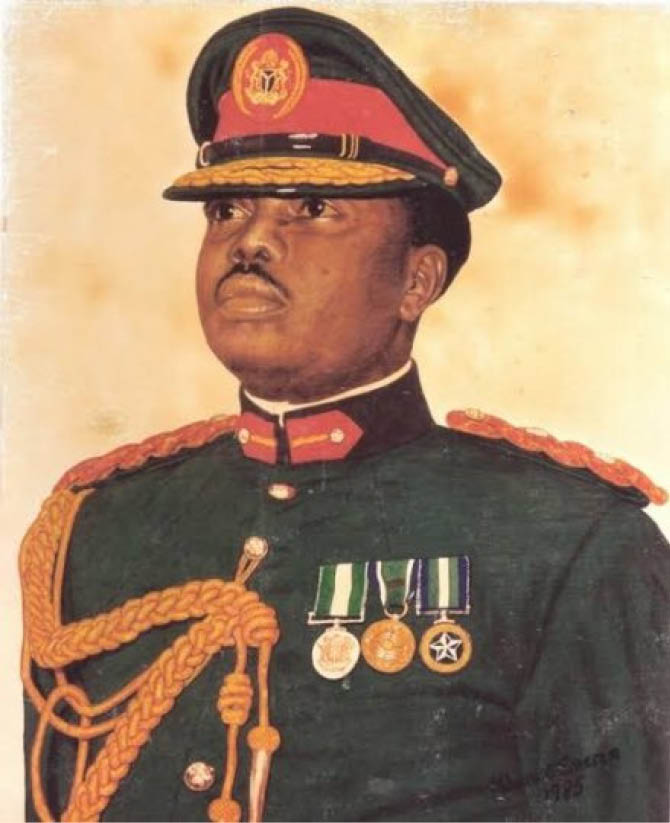
Arrested Development: Murtala Muhammed, 50 Years On
Fifty years ago, the crack of automatic rifle fire in the streets of Lagos did not just still the heartbeat of one man. It stilled the heartbeat of a continent’s ambition. General Murtala Ramat Muhammed’s 200-day leadership ended abruptly with it, taking with it a visceral, urgent dream for Nigeria and Africa that we have spent five decades trying, and largely failing, to reclaim.
To remember Murtala Muhammed is to remember a man in a hurry for a Nigeria and an Africa he believed had dallied long enough on the porch of history. He was impatient for progress, for accountability, for a continent that would finally chart its own cause. His patriotism was not the insular, rhetorical kind; it was a deep, foundational love that demanded results. From his very first address to the nation, he set a tone of uncompromising integrity, affirming a government that owed its people “justice, honesty and freedom from oppression.” He did not just speak; he acted, dismantling a corrupt and cumbersome civil service with surgical precision.
But it was on the continental stage that Murtala Muhammed became a colossus. His foreign policy was a clarion call for a new dawn. In an era defined by the Cold War’s bipolar grip, he audaciously carved a path of genuine non-alignment. For him, this was not a passive stance but an active assertion: Africa steering its own ship, choosing its friends based on mutual respect, and confronting its enemies based on their continued subjugation of its people. His philosophy found its most electrifying expression in his response to the Angolan crisis. While the West backed one faction, Muhammed saw the true stakes: the final, bloody battle against Portuguese colonialism and the insidious reach of apartheid South Africa. His government threw its weight unequivocally behind the MPLA, altering the course of Southern African history.
And how can we ever forget that epochal speech in January 1976 barely a month before he was murdered? As the Organization of African Unity teetered on the brink of division, Muhammed stood before his fellow leaders and delivered a thunderclap that still echoes through the halls of African consciousness: “Africa has come of age. It is no longer under the orbit of any extra continental power. It should no longer take orders from any country, however powerful. The fortunes of Africa are in our hands to make or to mar.”
It was a declaration of psychological independence. He challenged his peers to shed their timidity and act as the architects of their own future.
Fifty years on, we are left not just with the profound “what ifs” of his interrupted vision, but with the painful acknowledgement of how far we have strayed from the path he illuminated. The intervening decades, particularly since our return to civil democratic rule in 1999, have been a study in the slow, agonizing erosion of that very promise.
The high expectations that heralded the end of military rule were a direct inheritance of the Murtala Muhammed ethos, a yearning for a government that owed its people justice and honesty. We have witnessed a succession of administrations, each inaugurated with soaring rhetoric, yet the quality of governance has, by nearly every metric, dwindled. Where Murtala acted with surgical speed against corruption, successive governments have built a vast, unwieldy bureaucracy that often serves as a shield for the corrupt. Where he spoke with one voice for the continent, we now speak with a cacophony of contradictory voices, our influence diluted by internal political horse-trading.
Our internal contradictions, the very rot Murtala began to cleanse, have metastasized. The vision of a unified, purposeful nation has been fractured by the politics of ethnic and regional entitlement, a cynical manipulation that has turned citizens into subjects of their own identity. The state, once seen as the engine of progress, is now widely viewed as a predatory entity, an arena for primitive accumulation rather than public service. The “fortunes of Africa” that Murtala insisted were in our hands to “make or to mar” have, under our watch, been severely marred by incompetence, graft, and a failure to build the basic infrastructure of a modern state, from reliable power to functional education.
This internal decay has directly precipitated the waning of our continental leadership role. The Nigeria that once bankrolled liberation movements and dictated the terms of continental discourse is now a giant struggling to keep its own house in order. We are preoccupied with banditry, insurgency, and economic distress, leaving a vacuum that other powers, both African and extra-continental, are all too happy to fill. Our voice on issues of pan-Africanism is now muted, often reactive, and lacking the moral authority that Murtala’s Nigeria commanded. We have gone from being the architect of African consensus to a country often struggling to find its seat at the table of meaningful influence.
Murtala Muhammed’s vision was a direct rebuke to the trajectory we have since followed. The questions his legacy poses today are more urgent than ever: Is Africa truly “of age”? Do we determine our own fortunes, or are we still dancing to tunes piped from afar, our economic policies dictated by international lenders and our political will shackled by foreign interests? Do we exhibit that same deep, demanding patriotism that calls our leaders to account and ourselves to a higher standard of citizenship?
General Murtala Muhammed’s time was short, but his vision was vast. He showed us what a patriotic and pan-African leader should embody: one who loves his country enough to reform it, and his continent enough to free it from every form of bondage, including the self-inflicted wounds of poor governance. His unfinished work is the central challenge of our time. We owe his memory not just a wreath on a statue, but a Nigeria that works, and an Africa that is truly, and irrevocably, of age. Until we reclaim that audacious dream, our true development and global leadership will remain arrested.
Sa’id, a Communications Strategist, writes from Abuja
Nigerians can now invest ₦2.5 million on premium domains and profit about ₦17-₦25 million. All earnings paid in US Dollars. Rather than wonder, click here to find out how it works.
Join Daily Trust WhatsApp Community For Quick Access To News and Happenings Around You.
Community Reactions
AI-Powered Insights
Related Stories

How a Nigerian family saved a forest the world just noticed

Lafarge Africa Grows Revenue by 53%, to Reward Shareholders with Dividend

Nigeria’s 7 Million Disabled Children Deserve Better Access to Education


Discussion (0)