
Dangote Predicts Naira Will Hit ₦1,000 To $1 Before This Year, Backs FG’s Policies
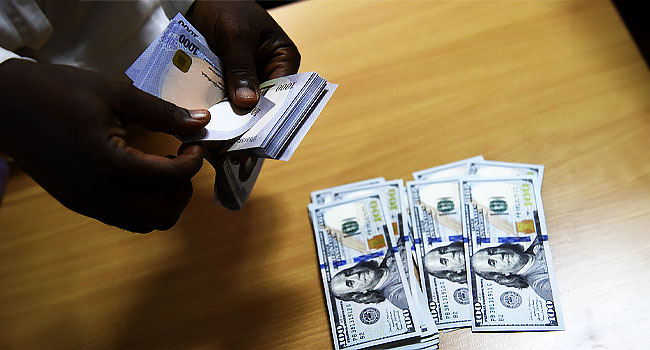
The Chairman of the Dangote Group, Aliko Dangote, has predicted the strengthening of the naira, saying the currency will hit ₦1,000 to $1 this year.
Dangote said this on Tuesday while speaking at the launch of the Nigeria Industrial Policy in Abuja.
While the naira goes for around ₦1,300 to a dollar, Dangote says the reforms by the government mean better days are ahead.
“I mean, today, if you look at it, Your Excellency, I believe with the policies that you have implemented in government, people now have started seeing the result, and manufacturers are very, very happy,” he said at the event attended by Vice President Kashim Shettima and other dignitaries.
“Today, the dollar is N1,340. Mr. Vice-President, I can assure you that, with what I know, by blocking all this importation, the currency this year will be as low as N1,100 if we are lucky. The only thing is for the government to stop the naira from getting stronger so that they will keep collecting more naira.
“But it’s a catch-22 situation where, now, if the naira gets stronger, it means that everything will go down. Everything will go down because we are an import-based country, which we shouldn’t be. What we should be doing is manufacturing all the things that we need.”
Dangote called for the protection of local investors through the provision of incentives and infrastructure, such as power, which he said remains a challenge to doing business in Nigeria.
According to him, while the policy is in order, it must be backed with full protection for industrialists to drive the nation’s goal for industrialization, job creation, and economic growth.
READ ALSO: Otedola Projects Naira Appreciation Below N1,000/$ Before Year-End
Last week, the Chairman of First HoldCo, Femi Otedola, also predicted that the naira would strengthen against the dollar and trade at ₦1,000/$1 before the end of the year, citing increased local refinery capacity in Nigeria.
At the event, Shettima described the role of the private sector as key to achieving the Nigeria Industrial Policy.
The Vice President said that Dangote Cement alone paid a tax of nine hundred billion naira in 2025.
The Nigeria Industrial Policy is expected to catalyze value addition, industrial linkages, and export competitiveness, among others.
Others who attended the event included the Secretary to the Government of the Federation, George Akume; representatives from the Manufacturers Association of Nigeria (MAN); the United Nations; and captains of industry.
President @officialABAT, Tuesday, unveiled Nigeria Industrial Policy 2025 with a charge to relevant ministries, departments and agencies (MDAs) of government to ensure speedy implementation.
According to him, the policy, which is a roadmap for re-engineering Nigeria’s industrial… pic.twitter.com/q91X6nQU8c
— Senator Kashim Shettima (@officialSKSM) February 17, 2026
At the event, President Bola Tinubu charged relevant ministries, departments, and agencies (MDAs) of government to ensure a speedy implementation of the policy.
He said, “The defining strength of this policy is its insistence on implementation. This administration will not measure success by the number of documents we produce.
“We will measure success by the number of factories that open their gates at dawn, by the jobs created for our young men and women, by the exports that leave our ports bearing the mark of Nigerian excellence, and by the value retained within our own economy.”
Tinubu, who was represented by Vice Kashim Shettima, regretted that for too long, Nigeria has grappled “with fragmented value chains, high production costs, infrastructure gaps, policy inconsistency, and insufficient coordination between government and industry.”
“We have realised that industrialisation is not a wish you think about; it is an action you perform. More than that, we must remind ourselves that this task demands coherence across energy, trade, infrastructure, finance, skills, and innovation. It requires partnership between the government and the private sector,” he stated.
According to him, the policy is a roadmap for re-engineering Nigeria’s industrial base, unlocking value across sectors, and placing production, competitiveness, and jobs at the centre of the nation’s economic strategy.
It has already established a clear implementation architecture, because policies rarely fail at conception but at execution, he said.
Community Reactions
AI-Powered Insights
Related Stories
Naira depreciates to N1,391/$ in parallel market

Stock Market Down Marginally as Investors Extend Profit-taking

Understanding the essence of banks recapitalisation policy


Discussion (0)